Music for Nerds: My love letter to the Ethel Cain project and Hayden Anhedönia’s storytelling.

Since the release of her debut album, Hayden Anhedönia (under the stage name Ethel Cain) has skyrocketed into indie-fame for her unique sound, prominent online persona and her incredible storytelling. But who is Ethel Cain? Why do we care, and what makes her so special?
The answer is so, so much. At least to me. The Ethel Cain project drowns the listener in emotion and a moment in time with dark ambient and dreamlike Americana sound. What I want to talk about is why it’s such a rewarding experience to pay attention to her art, to peel back the layers and really listen to what the music has to say.
In an age of easter-egg hunts and hyper-theorising on every minute detail of an artists persona to understand their art, searching for meaning and narrative within a song or album is hardly a new exercise – but what makes artists like Hayden Anhedönia so special is the experience of paying careful attention to not only the music, but the journey of the artist; the development and introduction of characters and the depths the listener can go to to understand the story. What makes Anhedönia’s storytelling so unique to current times is the lengths that listeners can go to draw conclusions about the art, her accessibility online, and utilisation of sites that can add clarification and meaning to her work.
In short, Anhedönia has created music for nerds who love homework and deep-diving into things without any regard for how crazy they might sound when they talk about things like the Daughters of Cain Cult, the Shady Grove Hurricane and, sure, why not, cannibalism!
So, who is Ethel Cain?
Ethel Cain is a fictional teenager in 80’s/90’s Alabama, who runs away from home and is eventually murdered by her boyfriend. Anhedönia has produced two full-length albums to flesh out the story of Ethel’s life, detailing friendships, crushes and her journey across the states to California, where she meets her end, Preacher’s Daughter and Willoughby Tucker, I’ll Always Love You.
Concept albums and embodying characters through album eras is not a new concept, of course. It has been done before and it will be done again – my first personal experience being fully aware of this was Melanie Martinez’s ‘Crybaby’, but of course there is Bowie’s ‘Ziggy Stardust’ and Pink Floyd’s ‘The Wall’ – but the development of Ethel Cain’s narrative is something that has had me in pieces since the first time I was introduced to her prior to the release of Preacher’s Daughter in 2022.
I’m not here today to outline everything that Anhedönia has ever told us or shown us through her music about the narrative she’s built; I highly recommend that you listen to Preacher’s Daughter and Willoughby Tucker yourself and draw your own conclusions, as that is half of the fun, but I do want to show some appreciation for this artist, character and narrative that has grown so close to my heart.
Before we get too bogged down in the textual stuff, I want to say that first and foremost that Ethel Cain’s albums and EPs are, as standalones without the attached narrative, are extraordinary bodies of work which I think can be enjoyed regardless of investment in the character. Following along from a musical standpoint, Anhedönia has developed her craft through different genres and through her own developing interests as an artist. From Preacher’s Daughter, to Perverts (an EP we’ll discuss another time!) and to Willoughby Tucker, each body influences the next, and just as a fan who has been awaiting each release with baited breath, it’s a relief and a pleasure to listen to Anhedönia improve upon her craft and develop a more sturdy, unique-to-her sound.
We unpack Ethel Cain songs the way we analyse poetry, understanding what is metaphorical and what is supposed to be literally happening within a song is sometimes intentionally abstract and sometimes more literal. Tracks like Thoroughfare seem pretty straightforward as you follow along with the lyrics, which tell the tale of an encounter between two people on the road toward the West Coast, decide to travel together and find themselves falling in love once they reach their destination. There is no reason to look deeper into the song – but you have the option to.
Taking a quick look at the lyrics page on Genius, you can see that Anhedönia herself has taken the time to annotate a few of the tracks on the record, giving us an insight into the less obvious details of the story – like the name of the lover Ethel found on the road, and who would subsequently be her murderer, Isaiah. You could say that this detail is unimportant, but it isn’t when you delve in a little deeper on the Ethel Cain iceberg.
As a 98’ baby like me, Anhedönia has spent a great deal of her formative years on the internet, for better or worse. She used to be very active on tumblr, where she would take to the blogging site to discuss the development of her music and the story of Ethel Cain, which she once said she planned on turning into a book. With Anhedönia once so readily available to discuss her vision for Ethel Cain on tumblr, twitter etc, fans who go the extra mile to research the extended lore of the albums find more and more reasons to listen and to engage with the music in the ways that a lot of fans just can’t with other artists, and because Ethel is a character, has a narrative that has already begun and ended, the listeners can sink their teeth into what they have been given through all these avenues and truly analyse what all of it means as a whole. There is a reason for all of it, a destination we are making our way to, and to invest in.
Anticipation, following along and listening in the moment:
Following the story in real time enhances the experience as being a fan of anything is, really. You’re there for the livestreams, the updates, anticipation makes a first-listen of an album all the more gratifying, but let me take you on a journey for a second:
Anyone who was already a fan of Preacher’s Daughter at least enough to take a look at the lyrics of the songs on Genius will have known at least the vague story of Ethel Cain – you might remember mention of Willoughby Tucker in the annotations of the lengthy 7 minute, 47 second ballad titled House in Nebraska, as Ethel’s first love.
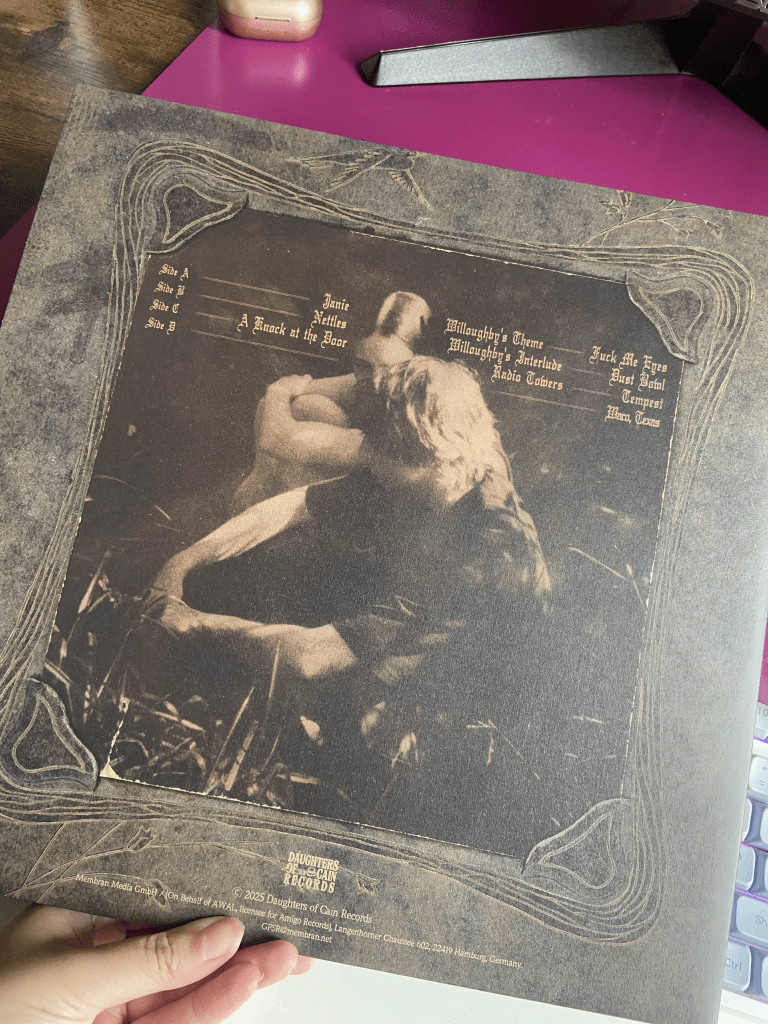
So imagine yourself as a long-time fan, scrambling to learn all you can about Willoughby Tucker after the announcement of Cain’s sophomore album, Willoughby Tucker I’ll Always Love You. Excitement builds, perhaps bordering on hysteria. You learn more about Willoughby through (at the time) demos of songs such as ‘Dust Bowl’ and snippets of the book Anhedönia teased on her tumblr, which detail the Hurricane of Shady Grove and the soul-crushing breakup between the two album-title characters. Fun, right?
The tracklist is released in anticipation of the album, you see ‘Dust Bowl’ (among other previously released demos) is receiving a full-release after two years of wondering if the Youtube reupload and singular live performance you can find of it is going to be all you get of the track – Hysteria. You also see a song titled ‘Tempest’ – perhaps alluding to the storm that we know broke up Ethel and Willoughby – Fear. One of the biggest questions as an Ethel Cain fan really is ‘what happened to Willougby?’, as this is a question that even Ethel herself wonders at in House In Nebraska, so the idea that we might be finally getting answers is a rush of mixed emotions.
No matter how deeply you pay attention to the things that Anhedönia has said, though, simply listening to the album is enough to translate what she is getting at.
Decoding the music: motifs, demos and immersion.
Let’s ignore the lyrics for a while, and just discuss the sound of the album and what it can tell us. As I said earlier, sometimes the tracks can be abstract and not outline in words a literal event or scenario, but the emotion behind it cuts cleanly through, giving the listener an intense reaction whether it be fear, empathy or intrigue.
An overarching texture throughout Preacher’s Daughter is the buzzing of flies, which to me foreshadow Ethel’s death as we associate the sound of swarming flies with rot. We hear them prominently in two tracks, Family Tree and Ptolemaea, while Ethel references ‘sun-bleached flies sitting on the window sill’ in the aptly titled Sun Bleached Flies, a song about acceptance and finding perspective in the end. On the lookout for other Easter eggs and knowing the small snippets of information Anhedönia has handed to fans throughout the years online and through Q&As, when Willoughby Tucker released, I was on the lookout for details like this and was not disappointed.
I already referenced the hurricane of Shady Grove and the related track, Tempest, so it should be no surprise when I say that wind and storm ambience plays a role in adding atmosphere and texture to the album. Wind chimes are present in Dust Bowl, in which Ethel sings “pretty boy, scared of the rain, by God” and “watching, hoping the wind blows slowly so I can keep you a moment”, we know for sure what is waiting for us when Tempest comes around. The conclusion of Willoughby’s Interlude faintly mimics a tornado warning siren as Anhedönia’s vocals drift in and out, alluding to something approaching, and finally, when Tempest begins, we hear the sudden start of rainfall – which comes to a sudden and crushing stop, leaving only the sound of howling wind as the music drops off somehow prematurely after a 10 minute long crescendo of lamentations.
Returning to the demos I mentioned earlier briefly, and the growth of Anhedönia as an artist, having listened to early, unreleased tracks such as Doe Hunting religiously, I can attest to the fact that it is all the more impactful as a fan when a previously unrecognised song gets her moment to shine in a full release. Dust Bowl was a particularly special release for me as a fan of the demo Anhedönia released on soundcloud and quickly deleted without explanation. The changes made from the demo to the full release are well worth the wait, noticing each change made with intention of hitting the listener hard with a drowning, dooming adoration for the subject of the song made me sob, recognising a moment of the demo version being included only to be hit with a wall of distorted guitars was a double-gut punch and actually made me sob with wonder when I first heard it with the speakers on full blast.
An unreleased track and all-time favourite demo of mine is Doe Hunting, so imagine my excitement when I realised she got a moment to shine in the form of a sample in Tempest, with slightly reworked lyrics.
These details pass an uninformed listener by on first listen, but the more you can gather about these characters and Anhedönia’s other works, the songs unfurl and become larger than life, consuming and devastating, which is what, to me, makes paying close attention to the Ethel Cain project as a whole so deeply rewarding and satisfying. Knowing the deeper cuts, listening to the unreleased tracks and analysing the music beyond lyrics and style opens up the world in ways I didn’t think were possible before I truly took a nosedive into the project
IN CONCLUSION:
In the way that Anhedönia writes her songs, interacts with fans and produces her music, it is obvious that great care has gone into this character, this world and her art. I hope that this essay inspires more people to take the time and care to really listen and appreciate what it is that she has built here as much as I do.

 MAISIE VIOLET WICKS